
If you've been researching treatment options for prostate cancer, two names keep coming up: TULSA-PRO and HIFU. Both use focused thermal energy to destroy cancerous prostate tissue. But how each device is guided, how energy reaches the gland, and how each protects the structures responsible for erections and continence are meaningfully different.
This comparison walks through those differences — guidance, energy delivery, treatment scope, and clinical evidence — so you can talk through the right questions with your care team.
Key takeaways
- TULSA-PRO uses real-time MRI guidance with closed-loop thermal feedback. Traditional HIFU is guided by ultrasound; MRI-guided HIFU systems (such as Exablate Prostate) also exist and use real-time thermal feedback, though they are less widely available than TULSA-PRO.
- TULSA-PRO delivers energy from inside the urethra outward ("inside-out"). HIFU delivers energy from a rectal probe inward ("outside-in").
- TULSA-PRO is commonly used for focal, hemi-gland, or whole-gland treatment. HIFU is most often used for focal treatment of smaller, well-defined lesions; whole-gland HIFU is technically possible but less commonly used because treating a larger volume outside-in raises the risk of rectal and urinary side effects.
- In the CAPTAIN trial, TULSA-PRO showed better quality-of-life scores than robotic prostatectomy in the first 30 days.
- Both are incision-free, outpatient, and radiation-free — the differences that matter most are in imaging, energy path, and tissue control.
Overview
About Integrative Urology
Integrative Urology is a Phoenix-based practice led by Dr. Y. Mark Hong, who trained at Stanford and Harvard and has personally performed more than 250 whole-gland TULSA-PRO procedures (sourced: Profound Medical, Nov 2025).
TULSA-PRO at Integrative Urology
- Real-time MRI guidance — treatment is monitored live, with closed-loop temperature feedback for tissue control.
- Inside-out ablation — energy travels from the urethra outward, which keeps thermal energy away from the rectum.
- Same-day outpatient care — patients go home the day of treatment; most resume light activity within about two weeks.
- Single-physician model — Dr. Hong performs each TULSA-PRO procedure personally.
- Whole-gland or focal flexibility — treatment boundaries are customized to the patient's anatomy.
Considerations:
- Requires MRI compatibility; certain pacemakers or metal implants need additional screening.
- Requires careful screening for candidacy, including anatomical factors and proper pre-procedure imaging
- Availability is concentrated at specialized centers, so some patients travel for treatment.
What is HIFU?
HIFU (High-Intensity Focused Ultrasound) delivers focused sound waves from a rectal probe through the rectal wall to the prostate. Multiple overlapping sonications cover the treatment zone.
Traditional HIFU is typically monitored with ultrasound; MRI-guided HIFU systems also exist but are much less widely deployed.
Benefits:
- Focal targeting of a defined lesion or zone.
- Incision-free, single outpatient session.
- No radiation exposure.
- An established option between active surveillance and more invasive treatment.
Considerations:
- Traditional (ultrasound-guided) HIFU doesn't provide the same real-time soft-tissue margin visibility as MRI guidance.
- Energy passes through the rectal wall en route to the prostate, which could damage the rectum or cause future problems.
- Most commonly used for lesions up to roughly 40 cc; some centers treat larger glands (50–60 cc) with adjunctive treatment such as short-course hormone therapy or a debulking procedure first.
- Whole-gland HIFU is technically possible but used less often, since treating more tissue from outside-in raises the risk of rectal and urinary/erectile side effects.
In-depth comparison
Imaging and guidance
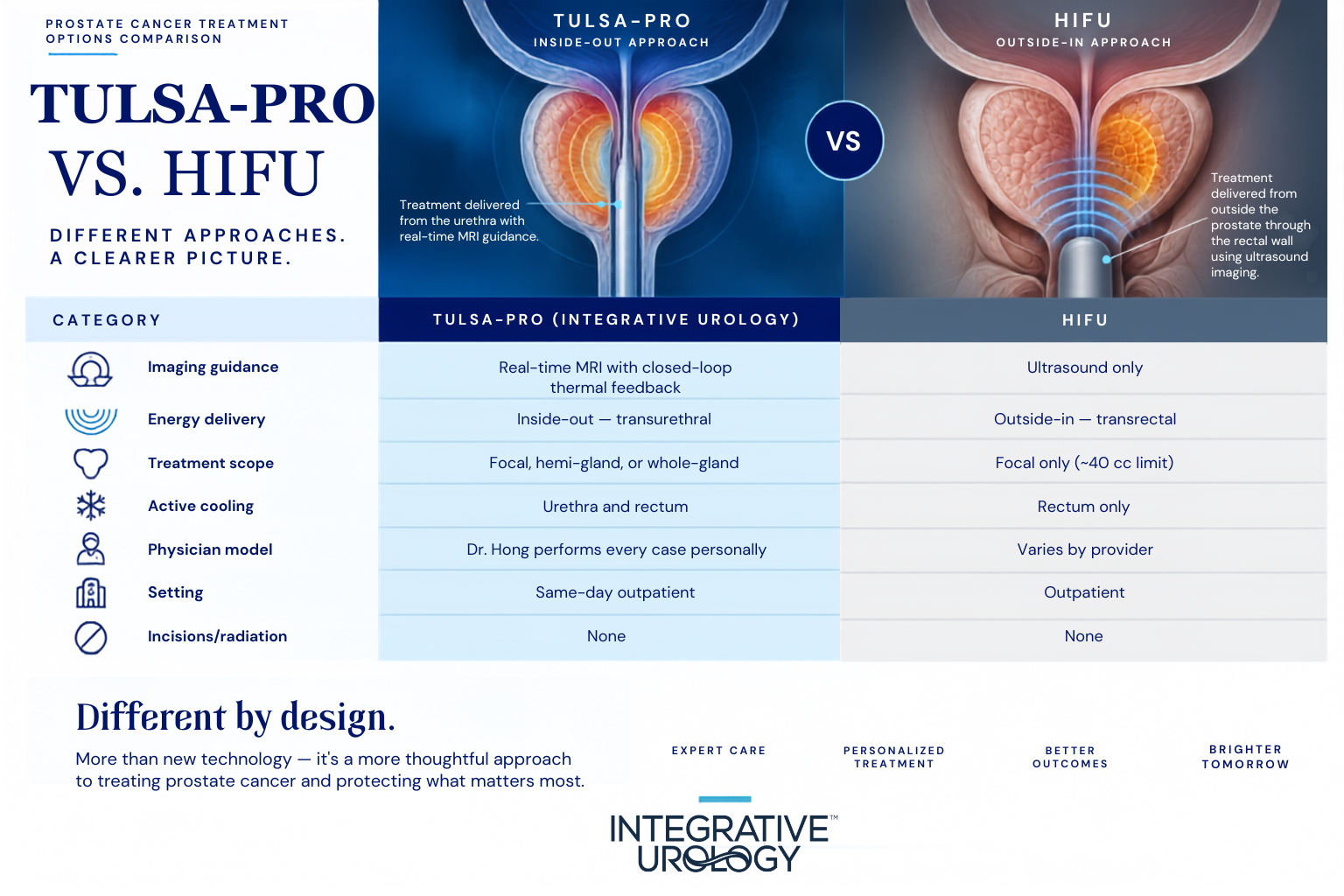
TULSA-PRO operates inside an MRI suite, giving the treating physician a live, high-resolution view of the prostate, the tumor, and surrounding structures throughout treatment, with closed-loop temperature feedback confirming energy stays within the planned boundary.
Traditional HIFU is monitored by ultrasound, which offers less soft-tissue contrast than MRI. MRI-guided HIFU systems close some of this gap but are not as widely available as TULSA-PRO.
Energy delivery
TULSA-PRO's transurethral device rotates inside the urethra, directing ultrasound energy outward toward the prostate boundary — an inside-out path that keeps energy away from the rectum, with active cooling of both the urethra and rectal wall.
HIFU's rectal probe fires focused sound waves inward through the rectal wall in overlapping sonications — an outside-in path that necessarily passes through non-target tissue before reaching the prostate.
Treatment scope
TULSA-PRO can be configured for focal, hemi-gland, or whole-gland ablation. HIFU is most established for focal treatment of smaller lesions (typically up to ~40 cc, with some centers extending this with adjunctive treatment). Whole-gland HIFU exists but is used more selectively due to the added risk profile of outside-in delivery at larger volumes.
Functional preservation
Protecting sexual function and continence is central to how TULSA-PRO was designed. The CAPTAIN head-to-head clinical trial (211 men, 23 sites) showed better quality-of-life scores for TULSA-PRO than robotic prostatectomy in the first 30 days.
Clinical evidence
TULSA-PRO is supported by the CAPTAIN randomized controlled trial and the TACT pivotal FDA registration trial.
HIFU has prospective registry and single-arm study data with multi-year follow-up confirming oncologic control in well-selected focal cases. A head-to-head randomized trial between HIFU and a comparator has not been completed at the scale of the CAPTAIN trial.
Comparison table: Two focused ultrasound approach for localized prostate cancer
Different approaches. Different considerations.
There isn't one treatment path for every prostate cancer diagnosis. Start by understanding your options—then decide what fits yours.
Choosing between them
There isn't a single right answer for every diagnosis. The better fit depends on tumor location, prostate volume, and your priorities for recovery and preservation of function — which is exactly what a candidacy consultation is for.
Want to learn more about candidacy for TULSA-PRO? Check out our Candidacy Page.
Why Integrative Urology Is a Top Choice for your Focused Ultrasound Prostate Treatment
You didn't spend decades building your life, your relationships, your career, your sense of who you are, to hand it all over to a treatment that guesses where the boundaries should be. Integrative Urology gives you MRI-guided precision that sees, measures, and confirms every boundary in real time.
Dr. Hong has performed among the most TULSA-PRO treatments in the world independently as a urological surgeon. He does it himself. Personally. The CAPTAIN trial isn't a talking point. It's Level 1, randomized evidence that proved TULSA-PRO preserves erections and continence at more than twice the rate of robotic prostatectomy.
Your identity is not negotiable. Choose the path that protects who you are. Find out if you're a candidate or schedule a consultation with Dr. Hong.
FAQs: TULSA-PRO vs HIFU for Prostate Cancer in 2026
What is the main difference between TULSA-PRO and HIFU?
TULSA-PRO treats the prostate from inside the urethra outward under live MRI guidance, while HIFU sends focused ultrasound from a rectal probe inward through the rectal wall using ultrasound imaging guidance. Integrative Urology's TULSA-PRO also actively cools both the urethra and rectum to protect surrounding structures.
Can HIFU treat the entire prostate gland?
No. HIFU is a focal-only approach designed for smaller, well-defined lesions up to approximately 40 cc. If your cancer is multi-focal or you need whole-gland treatment, Integrative Urology's TULSA-PRO offers that flexibility in a single session.
What does the CAPTAIN trial say about TULSA-PRO outcomes?
The CAPTAIN trial, presented at EAU 2026, showed that men treated with TULSA-PRO were more than twice as likely to preserve both erections and pad-free continence at six months compared to robotic prostatectomy. Integrative Urology uses this same technology under Dr. Hong's direct care.
Is TULSA-PRO or HIFU a better fit for preserving sexual function?
TULSA-PRO's inside-out delivery and active nerve-bundle cooling give it a structural advantage for protecting the nerves responsible for erections. Integrative Urology's clinical data shows 87% of men preserve erections at five years after whole-gland treatment.
How quickly can I return to normal life after TULSA-PRO?
Integrative Urology performs TULSA-PRO as a same-day outpatient treatment. Men typically resume light activities in days. The CAPTAIN trial confirmed that TULSA-PRO patients returned to work in a median of 10 days, compared to 19 days after robotic surgery.
Do I need to travel to get TULSA-PRO treatment?
Integrative Urology is located in Phoenix, Arizona, and men travel nationally and internationally for Dr. Hong's expertise. The practice offers concierge-level support to coordinate consultations, pre-treatment planning, and follow-up care for out-of-town visitors.